What is Unicode and How Unicode Fonts Works: The Plain English Guide to Digital Text
Unicode is the global computing standard that allows every computer, smartphone, and tablet to display text consistently. Computers do not understand letters or words directly. Microprocessors only process numbers, electrical signals, and binary code.
Every time you type a letter on your keyboard, your device converts that keystroke into an assigned number. Online tools like a cute font generator use these character numbers to create decorative text for Instagram bios, Discord handles, and TikTok captions. This guide explains how Unicode works, why character encoding matters, and how styled text travels across the web.
1. The History of Text Encoding: From ASCII to Unicode
Early computers used the American Standard Code for Information Interchange, commonly known as ASCII. Developed in 1963, ASCII used a 7-bit binary system that supported only 128 total characters. This small table included English uppercase letters, lowercase letters, numbers, and basic punctuation marks.
International communication broke down as personal computing spread across Europe, Asia, and Africa. Different countries created incompatible 8-bit encoding tables like ISO-8859-1 and Shift JIS. Opening a document written in one country on a computer in another country often resulted in scrambled text known as mojibake.
Engineers from Apple, Xerox, and Microsoft formed the Unicode Consortium in 1991 to solve this global fragmentation. The latest Unicode version 16.0 contains 154,998 standardized characters representing 168 modern and historic scripts, alongside thousands of mathematical symbols and emoji.
2. How Unicode Code Points Work
Code points represent the core identification numbers assigned to every character in the Unicode database. Programmers write code points using the prefix U plus four to six hexadecimal numbers.
The standard Latin capital letter "A" holds the permanent code point U+0041. When an application receives code point U+0041, it searches your device's installed system fonts to draw the correct visual shape on your screen.
Unicode organizes all character codes into 17 planes. Each plane holds 65,536 individual code points. The table below demonstrates how standard letters map to different specialized Unicode planes:
| Character Description | Unicode Code Point | Unicode Character Block | Rendered Glyph |
|---|---|---|---|
| Latin Capital Letter A | U+0041 | Basic Latin (Plane 0) | A |
| Mathematical Bold Capital A | U+1D400 | Mathematical Alphanumeric Symbols (Plane 1) | 𝐀 |
| Mathematical Script Capital A | U+1D49C | Mathematical Alphanumeric Symbols (Plane 1) | 𝒜 |
| Mathematical Fraktur Capital A | U+1D504 | Mathematical Alphanumeric Symbols (Plane 1) | 𝔄 |
| Circled Latin Capital Letter A | U+24B6 | Enclosed Alphanumerics (Plane 0) | Ⓐ |
3. How "Unicode Fonts" Actually Work in Social Media Apps
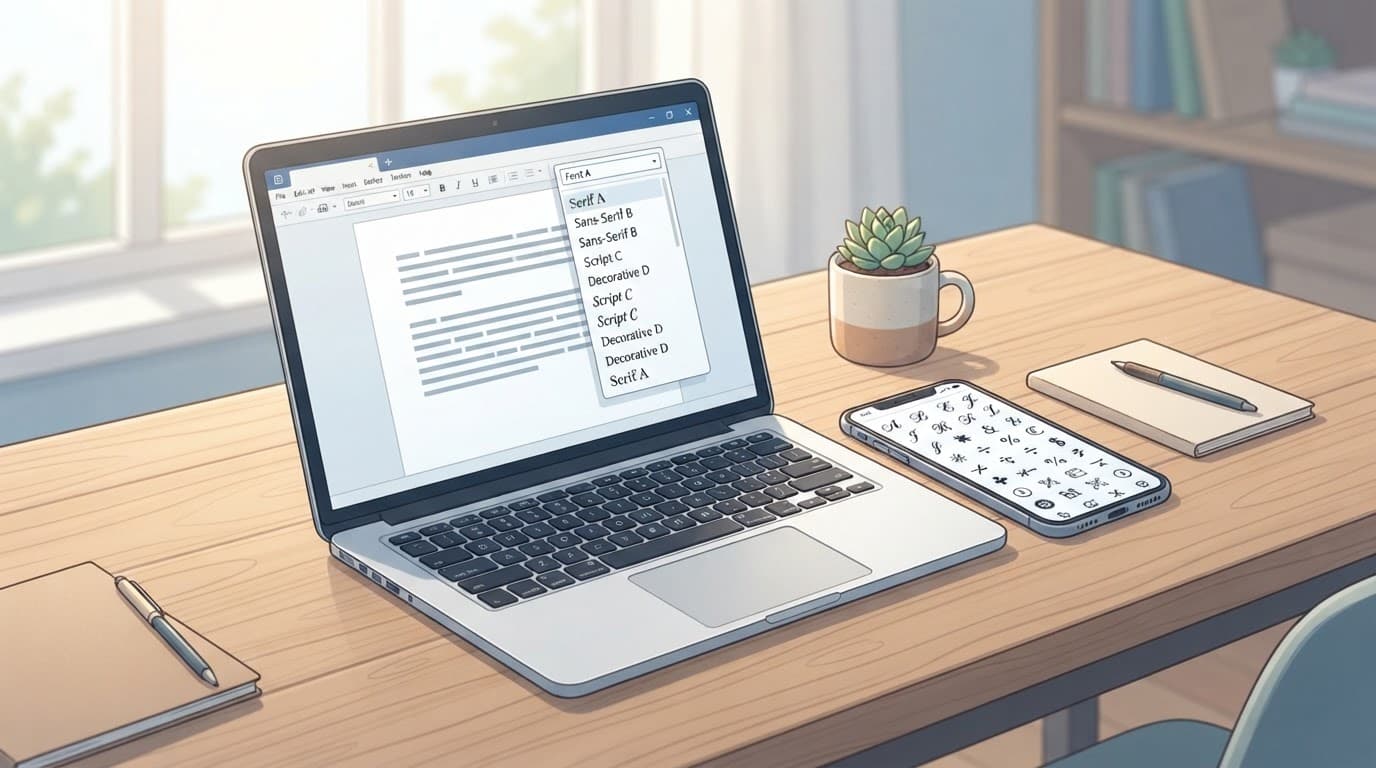
Unicode fonts are not real typeface files like TrueType (.ttf) or OpenType (.otf). Real font files change how your computer draws every normal letter inside a specific desktop program like Microsoft Word.
Social media websites do not let users upload custom font files into comment fields or profile bios. Instead, text tools map your input letters to corresponding mathematical symbols located on the Supplementary Multilingual Plane.
When you generate bold text characters or use an italic font generator, the software replaces standard letters with distinct mathematical symbols.
The receiving app treats those symbols as plain text characters rather than formatted words. For a detailed breakdown of desktop vs web text tools, review our font generator guide.
4. Why Do Some Devices Show Blank Boxes or Question Marks?
Device manufacturers bundle their own fallback font files inside operating systems. Apple devices use Apple Color Emoji and San Francisco, Windows uses Segoe UI Symbol, and Android devices use Noto Sans.
When you paste complex gothic font styles on an older smartphone, the phone's rendering engine checks its installed font tables for that specific code point.
If the manufacturer did not include visual glyph data for that character block, the operating system draws a fallback symbol. This fallback symbol usually looks like a hollow rectangle, an empty box, or a question mark inside a diamond.
Frequently Asked Questions
What is the difference between ASCII and Unicode? ▼
ASCII is an older encoding standard that only supports 128 English characters and control codes. Unicode is a global standard that assigns unique code numbers to more than 154,000 characters from all living and historical languages.
Why do Unicode fonts work in social media bios without installing software? ▼
Social media apps read Unicode characters as standard text data rather than graphic files. When you paste mathematical symbols from a generator, the app displays the built-in system glyph assigned to that exact universal character code.
What does a Unicode code point look like? ▼
Unicode code points use hexadecimal notation starting with the prefix U plus four to six letters and numbers. For example, standard capital letter A is written as U+0041, while mathematical bold capital A is written as U+1D400.
Why do some devices show a box or question mark for certain Unicode symbols? ▼
Older operating systems lack visual font data for symbols added in recent Unicode standard updates. When an operating system cannot find a matching visual shape for a code point, it renders a fallback rectangle known as tofu.
Does using Unicode styled text change how search engines index words? ▼
Search engine spiders treat mathematical alphanumeric symbols as independent special characters rather than standard letters. Writing important keywords in decorative symbols can prevent automated search crawlers from matching normal search queries.